The Detective Wall
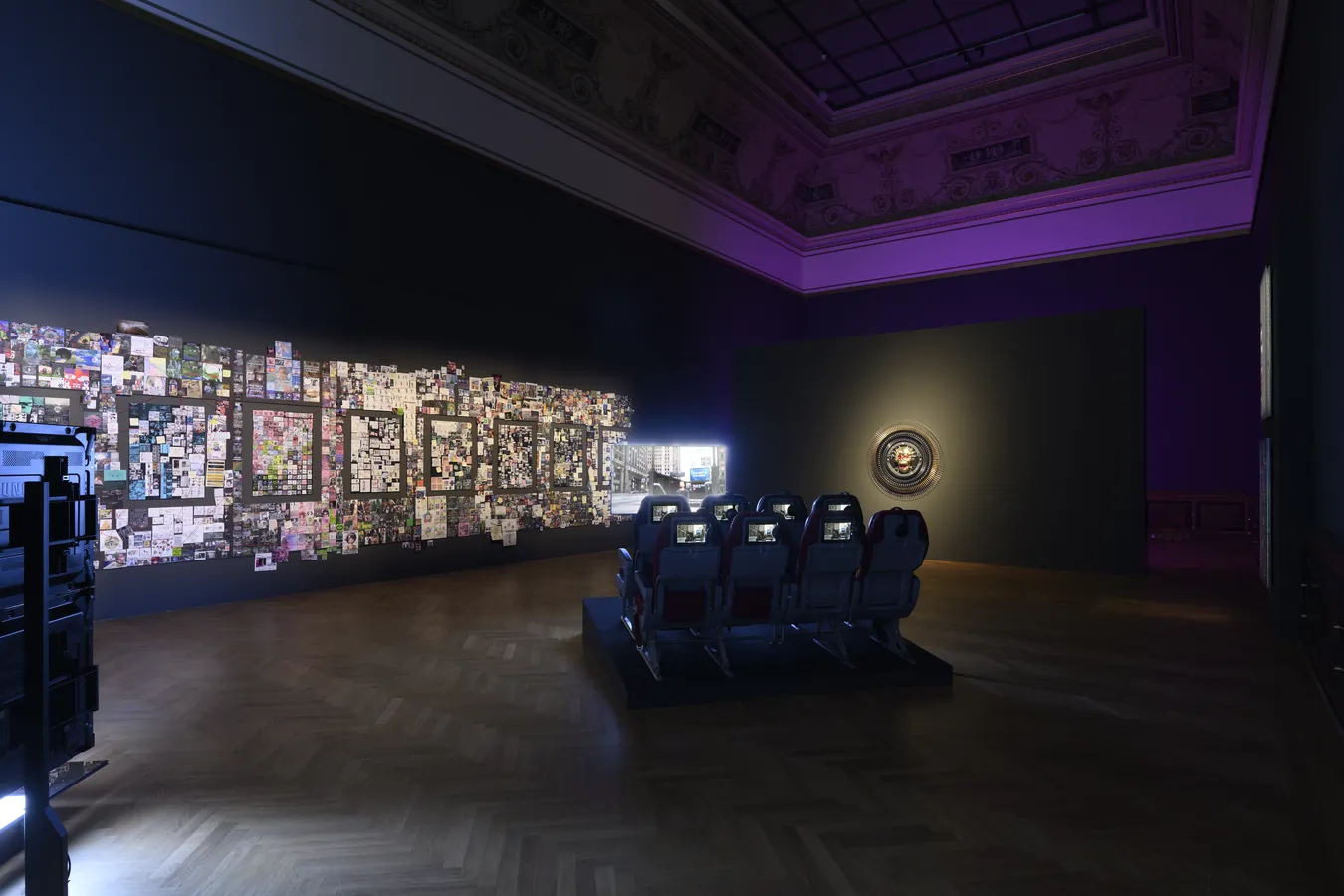
The Detective Wall is an integral part of Meme Manifesto, a transmedia project, which seeks to represent, understand and archive the social, cultural and visual forces behind the global spread of memetic culture.
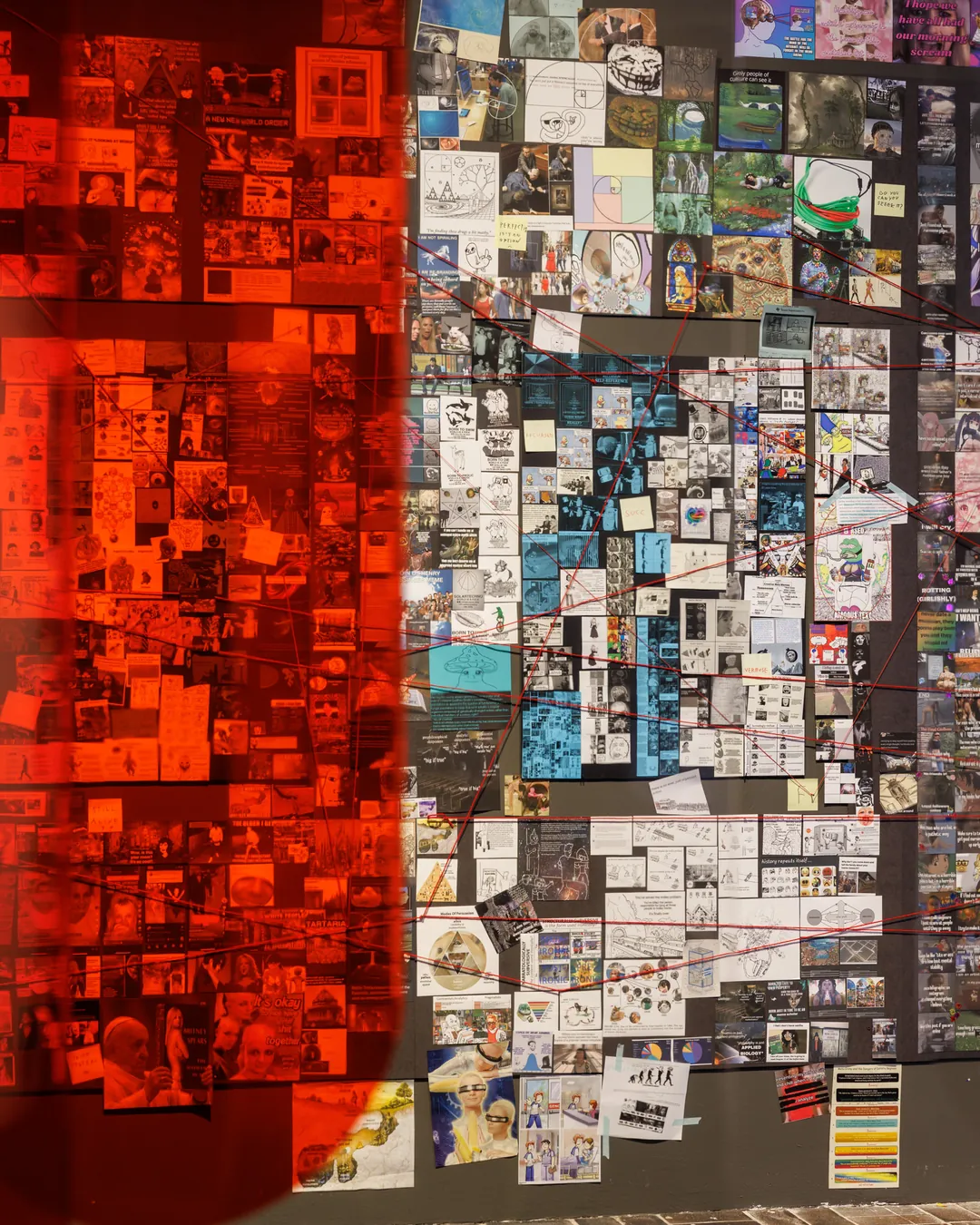
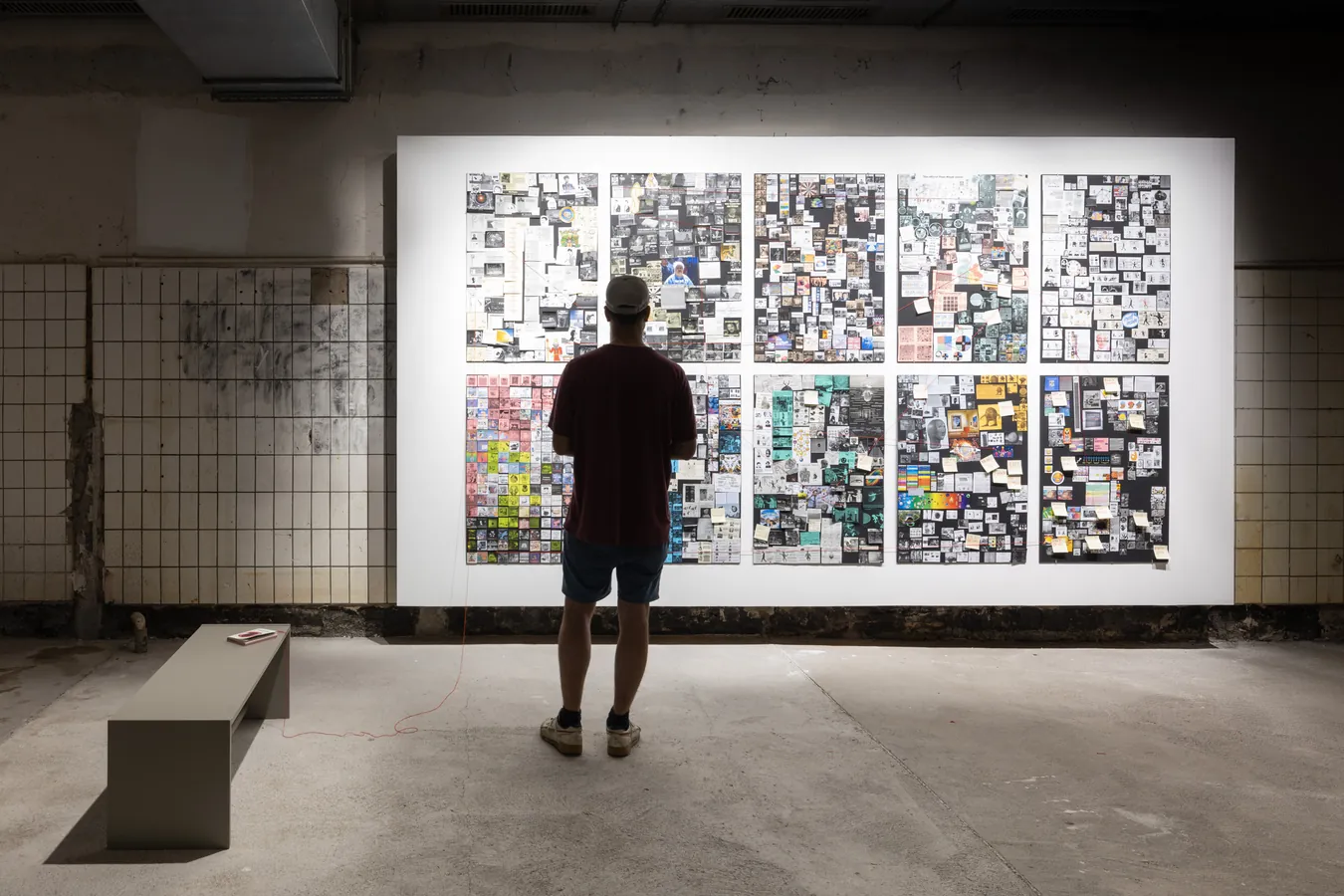
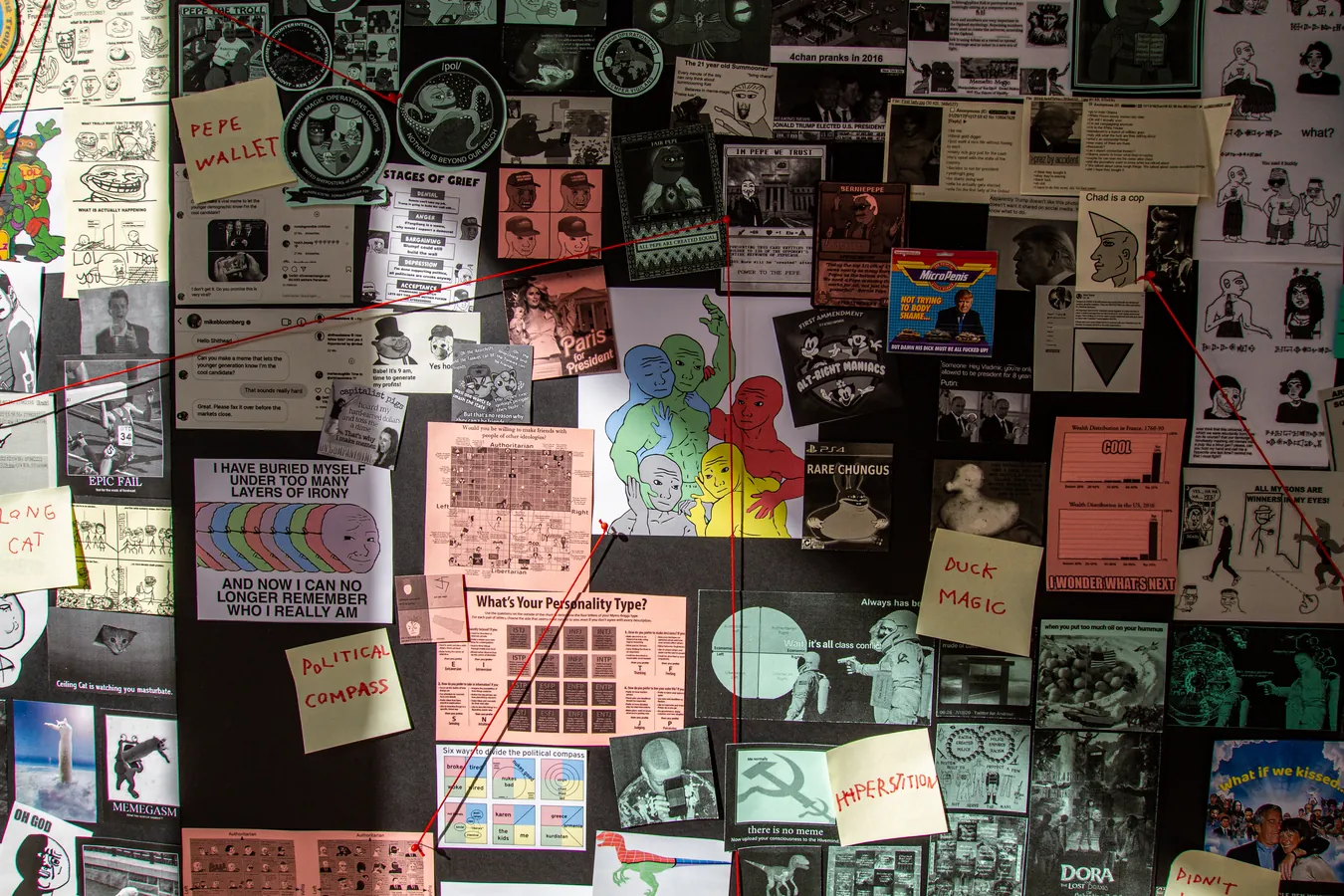
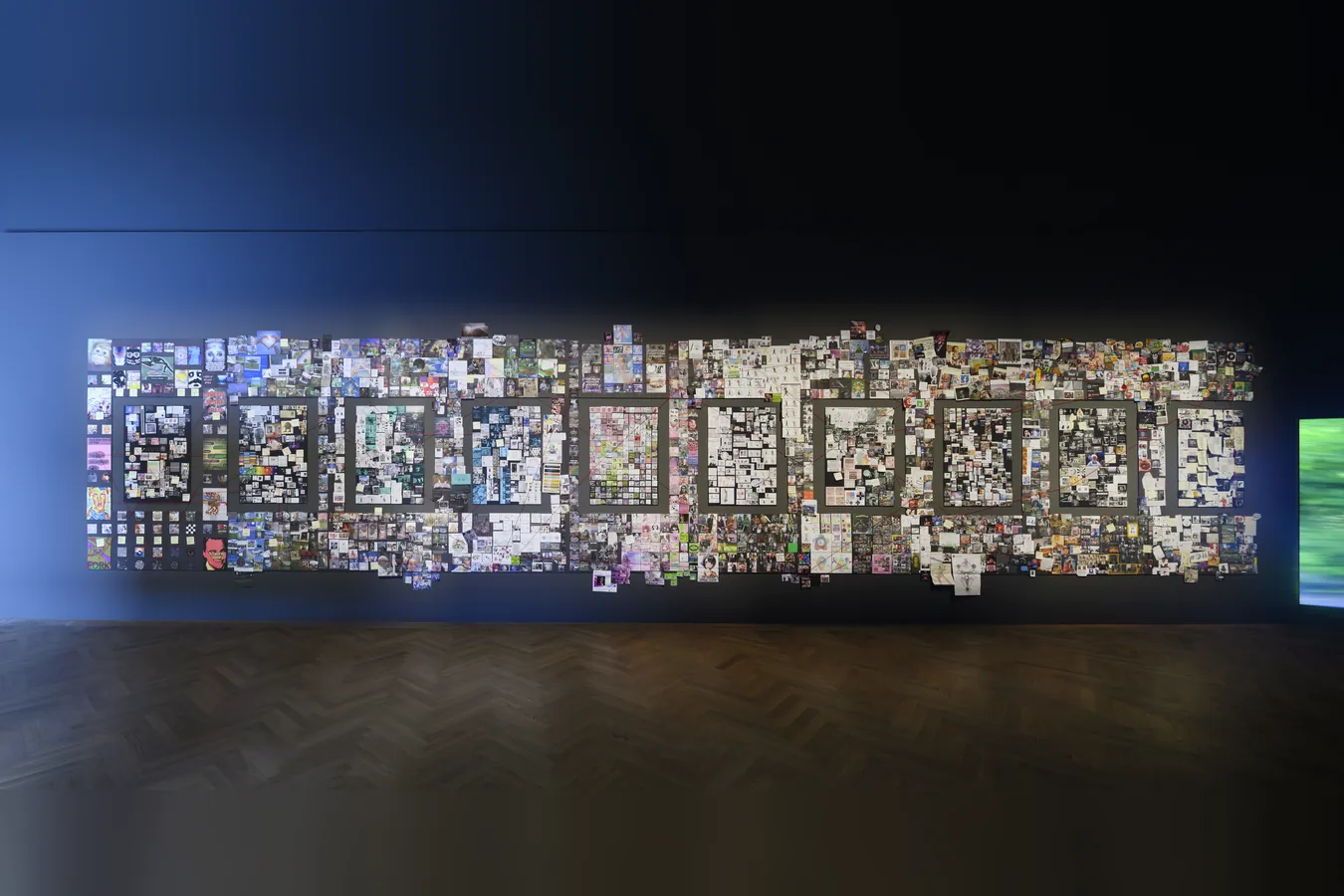
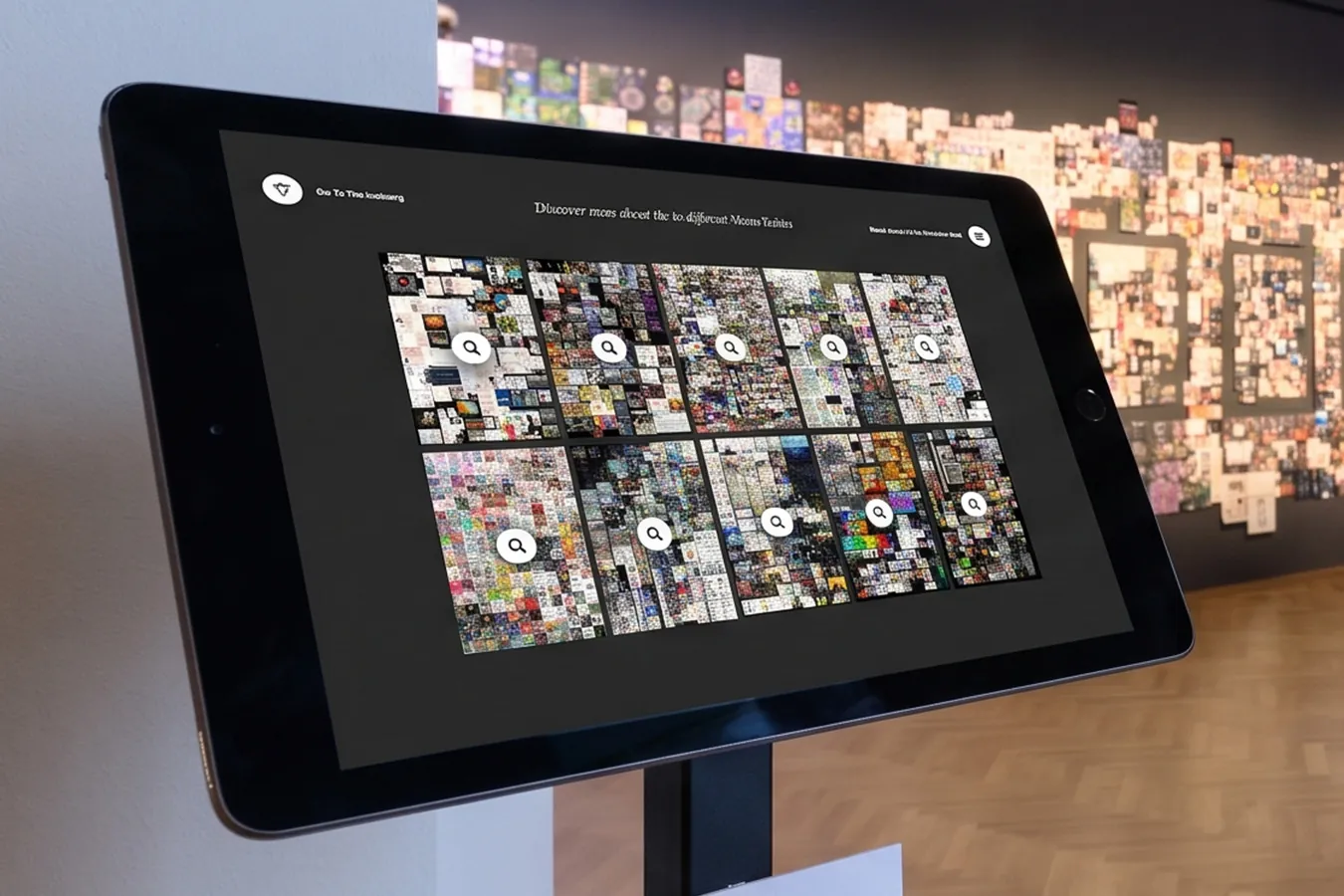
A modular installation mapping the memesphere, The Detective Wall draws on Aby Warburg’s Mnemosyne Atlas and the “crazy walls” of detective films. Its 14 × 2.5 metre structure brings together seven years of research by Clusterduck, developed through workshops, talks, archive-building and ongoing conversations with researchers and experts in meme studies.
Built at a time when internet theory was just beginning to take memes seriously as a powerful medium of communication, the wall traces their visual languages, connections and mutations. Memes may have started “for the lulz”, but they are now used by all kinds of actors for marketing, politics and propaganda. Learning to read them means understanding how meaning travels online, recognising the mechanisms of memetic warfare and questioning the beliefs they help spread.
As we wrote: “Memetics had grown, becoming ever more complex – and so had we. We had now reached the point where we could stand in front of the Wall for hours, explaining to some poor, unaware visitor the story behind each of those yellowed paper images, rambling about how each image connects to the others – how it all tells the story of the past decade of our lives”.
Exhibitions
- Poetics of Encryption, curated by Nadim Samman, Galerie Rudolfinum, Prague, 2025.
- Poetics of Encryption, curated by Nadim Samman, Kunsthal Charlottenborg, Copenhagen, 2024.
- Poetics of Encryption, curated by Nadim Samman, KW Institute for Contemporary Art, Berlin, 2024.
- Meme Manifesto, curated by Vittorio Parisi, Villa Arson, Nice, 2022.
- Meme Manifesto at Kepler’s Gardens, Ars Electronica, Linz, 2020.
- Meme Manifesto, Aksioma, Ljubljana, 2021.
- Clusterduck at Move To, Werkleitz Festival, Halle (Saale), 2021.
- #MEMEMANIFESTO, Drugo More, Rijeka, 2021.
- #MEMEMANIFESTO, Dutch Design Week, Eindhoven, 2020.
- The Detective Wall, Haus der Statistik, Berlin, 2020.
Residencies
- EMAP/EMARE Residency, IMPAKT, Utrecht, 2020–2021.
- Next Cloud Residency, servus.at, Linz, 2021.
Publications
- Clusterduck, A Meme Manifesto Project: How We Grew Up While Mapping the Memesphere, Archivio, The Tech Issue #11, 2025.
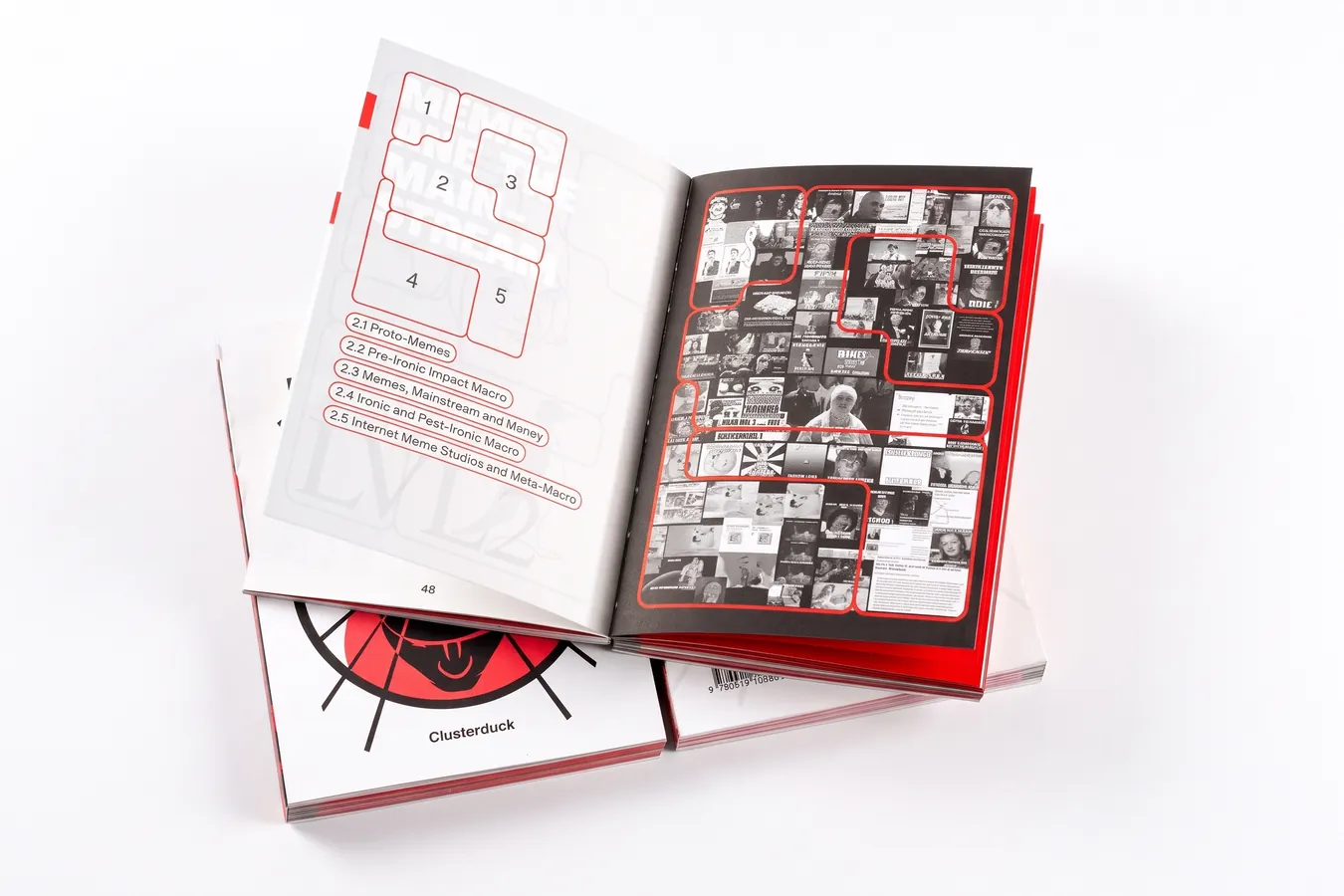
- The Detective Wall Guide, Aksioma and IMPAKT, Ljubljana, 2021.
- Memes and the Anti-Archive, Foam Magazine #59: Histories, 2021.
- Meme Manifesto. El laboratorio Freeport, Matadero Estudios Críticos, Vol. 3, Madrid, 2021.
- Meme Manifesto, Salat Magazin, Post Future, Issue #4, 2021.
Interviews & Press
- KW Studio about Poetics of Encryption, KW Institute for Contemporary Art, Berlin, 2024.
- Rebecca O’Dwyer, “Poetics of Encryption”: Can Algorithms Access Hidden Knowledge?, ArtReview, 2024.
- Kate Brown, An Uncanny Exhibition Turns the Online World Into Artistic Material, Artnet, 2024.
- Sebastjan Brank, “Poetics of Encryption” at KW Institute for Contemporary Art, Spike, 2024.
- Laura Cocciolillo, Poetics of Encryption, Kunsthal Charlottenborg / Copenhagen, Flash Art, 2024.
- Caterina Avataneo, Poetics of Encryption, curated by Nadim Samman, Cura, 2024.
- Jutta Zaremba, Meme-Manifeste. Transmediale Strategien des Clusterduck-Kollektivs, Kunstforum International, 2022.
- Vanni Santoni, Il potere passa dai meme, Corriere Fiorentino, 2021.
- Clusterducks Residency Recap, Why #MEMEMANIFESTO?, Impakt Blog, 2021.
- Donald Gjoka, Clusterduck New Era, Coeval Magazine, 2020.
Talks & Workshops
- Dank Images, TikTok und Apokalypse. Bildhandeln im Internet, Goethe-Universität Frankfurt, Universität zu Köln, Mozarteum Salzburg/Innsbruck, 2023.
- From Meme Magic to TikTok Realness, TU Dresden, 2023.
- Memes as Hyperstitional Technology, Aksioma, Kino Šiška, Ljubljana, 2021.
- Stock Memes, The Freeport Protocol Screen Walk, The Photographers’ Gallery, London, 2021.
- Thanks for all the memes | cảm ơn vì tất cả đống meme này, Sàn Art, British Council, Saigon, 2021.
- #MEMEMANIFESTO, The Freeport Protocol, 30-hour seminar, Matadero, Madrid, 2020.
- Meme Manifesto in Gardens of Darkness, Garden of Light, Ars Electronica, Linz, 2020.
- #MEMEMANIFESTO, IMPAKT Festival, Utrecht, 2020.
- Meme Culture and its Discontents, Heinrich Heine Universität, Düsseldorf, 2020.
Credits
- The Detective Wall was conceived and developed by Clusterduck’s co-founders as part of Meme Manifesto. Tommaso Cappelletti, Silvia Dal Dosso, Francesca Delbono, Arianna Magrini and Noel Nicolaus worked collaboratively across concept development, art direction, brand identity, copywriting, editing, production, project coordination, UX design and content curation.
- Jules Durand, Symbol Design and Typography Consultancy.
- Gregorio Magini, Web Development.
- Pietro Parisi, WebGL Development.
- Umberto Boschi, Telegram Bot Research.
- Esben Holk, Björn Heerßen, Wall Installation Support.
- Marc Tuters, Introduction to The Detective Wall Guide.
- DJ Detweiler, Sound Composition.
Partners
- EMAP/EMARE.
- KW Institute for Contemporary Art.
- Fondazione Paul Thorel.
- Freeport Lab.
- Green Cube Gallery.
- IMPAKT.
- Institute of Network Cultures.
- The Influencers Festival.
- Villa Arson.
- Werkleitz Festival.
Wall Contributors
- The names listed below are artists, memers, researchers and spaces that allowed Clusterduck to let this project grow over the years. Many of them are original content creators we got to know through our explorations and decided to include in this crazy mapping of the memesphere, which went on for seven years. While we may sympathise with the ideals of some and strongly disagree with the messages of others, we believe that including a wide range of perspectives is essential to understanding the broader context: a first step on the long way to learning how to protect each other.
- Artists, OC, quotes: _hellojello, _not_today_god_, 000vacio000, 3am-4ng3l, 5d.4n4l.53x, 5ickly, 9dividedby3, a_boy_crab_, a13sweatermuppet3.0, ad-wills, afffirmations, affordablefoiegras, alchememes__, Alfredagren, alpharivelino, alvinlucier, amfq, andise, andonuts, anima.memetica, anons, anthr0shit, antihero, arcane_wit, arcanebullshit, architekturrebellion.berlin, AtlantiqueNord, awgweirdcore, b0rscht, babylonsgreatesthits, baseballscenefromtwilight, basedbestie, bastardcontent, blackgirlproblemsofficial, Bob Averill, bradtroemel, Brian Bundesen, brokenlipstickgirl, brutalrecovery, cakitakuki_2_tokyodrift, camillepawglia, camthebatmanfan, Carlos Ramirez, cascadedreamer, chadocracie, Character Studio, CiLcKi4jSA2, CipherRephic, coryintheabyss, cream.ur.tartar, crudeliamemon, Cuauhtémoc Moctezuma Brewery, Cx_H3SPOA26, cyaomamma, cyb0rgan1c, da_jekyll, Dallenson, dankzestykale, dayyyofff, delicatethunders, demonflyingfox, depthsofwikipedia, derangedposts, Derap_, Despair.inc, destruction1999x, Diamondhead, djinn_kazama, do.not.research, don_elektrq, donotresearch_thefifth, dopamemequeen, dreamersofthenewaion, drew11111111111111111111111111, dropcity_org, drunkenbeggar, dxrknessgd, dyingbutfine, EFG, emilie_in_montreal, esoteri.cum, eternalstonergirl, etherealascend, ethicaldesign69, eyes_of_the_devine, FancyCat (unconfirmed), feedthemcats, FirstFork, floatuniverse, freud.intensifies, frog, fuvk.mp4, gabagoolectuals, Gabeagoo, gayhorror666, gayvapeshark, Geoffrey Lee, gigizerotwo, giovanesessopiedidellatrap, girlfromwebsite, girlgigglingandgirlfailing, girlybullshitmemes, GNAA, Gnikeht, Golden_Lynel, goobers-weirdcore, hardycoreman, Helen Power and Chris Boyle of Privateisland.tv, hidden.ny, HOLLA ATCHA BOI, hor_ney_outer_spa_ce_posting, hshtghshtg, human_posting, iamdelusional_, ihavespideysenses2, inchiestagram, isthissanjunipero, jared_memelolol, jeffluvsmilfs, juulpuppy, k.o.t.z, katkithh, KC Green / TehEman, King Gawjuss, kookyfonts, kornsexual, lamuertedeunperrito, leesaunknown, livekindly, LOLTumblrWallpapers, longtoeslonglegs, lordgod_lucifer, losangeleslayers, ludacris, luftmarian, m3m3pl3x, madonnafreeeda, males_are_cancelled, MaryjaneBrewington, matrix0ffline, Matthias Fritsch, Matty Roberts, meaningful_incellectuals_only, meme_for_speed, meme.phistopheles, meme.research.and.development, memeanalyses, memecalcistici_x_tifosimistici, memeclassworldwide, memesforskumbags, memetic.magick, millennial_misery, iamfuckingmagic, freeze_magazine, misterjip, mkr-2002, moistbuddha, moon-fence, morecorecore, mylifeisupsetting, not.not.reading, not.yr.boyfriend, nottrain, noughties_nostalgia, nude_emperor, number1buongiorno, obese.dogma777, ocay, okschizo, papachillis_memekkake, papachillis_memepie, pauvreoison, Peirson, penguin_explains, peteypiranha128, philosophical.genes, philosophy_lol, pipesbuffet, pirateflavor, Pit_27, PoliticsAndEd, poorspigga, postdeathmemes, postp0stpost, Praetox Technologie, pralines__and__dick, promnightdumpsterbaddie, r/BetterDeepFriedMemes, r/bigbangedmemes, r/blackholedmemes, r/BlueFriedMemes, r/BoiledMemes, r/button, r/DeepFried/, r/formuladank/, r/GlitchedMemes, r/HardBoiledMemes, r/KentuckyFriedMemes, r/Microwavememes, r/nukedmemes, r/place, r/starsector, r/virginvschad, Raffi, RealPapaPit/KamoKatt/gn3xu5, Reimu_Hakurei, renaissance__man, reptilian-underlord, Rethy11, rinnyriot, RokeRot, sadpeoplememes, samsarateens, sanepepsihatr, saqmemes, sexters_laboratory, shitpostingqueen69, shymemendrix, sitting_in_stagram, societyiftextwall, spinacialleverdure, squigglemoon, ssslvdr, Stenis_, stratiuniti, superinternet.space, Tabatha, tape.wyrm, Teakay, teenagestepdad, terrorizzm, th0tssharethoughtz, the.commons.earth, thebottomtext, theinternetangels, thisisafleshprison, tim963x, Tolunay, tuxedomanlet, twunkthetwink, tx9k, u/49379791, u/Gnikeht, u/PizzaLater, undercoverosh, Up2Admin, vaberagaa, very_intresting_images_, violentlyepic, voidofstyle, vvsleepy, wberry, weird-coby-core, weirdowoke, weltenhumor, whatif.iwas.lain, wholemilk, williamsborrowed, wipeyadocsoff, worstigaccount, wzr0713, YaboiRobocop, yagirlyubnub, yeoninboi, youradoringluvr, zegalba.
- Contributors and friends: Aarón V. Bouzas, Alessandro Mininno, An Xiao Mina, Canek Zapata, Carla Rogel, Carolina Fernández Castrillo, CERN Internet Department, Daniela De La Torre, Daniele Zinni, Dank Images Research Network, Dario Alì, Doreen A. Ríos, dyne.org, Elena Pérez, Elisatron, Ellie Hain, Esben Holk, Eva Garate, Geert Lovink, Felt Zine, Iconografie, Idil Galip of Meme Studies Research Network, INC Meme Reader, Karina Sheikh, Lily Dollner, Linda K. Börzsei, Ljubljana Protocol Participants, Mara Oscar Cassiani, Marc Tuters, Masha Zharova, Meatverse, Michiel Teeuw, Noura Tafeche, Pavel Goncarov, Projecto Una, Proyecto Televética, Ryan Broderick, Ryder Ripps, Saigon Protocol Participants, Screen Walks Protocol Participants, Seong Young Her, Shumon Basar, Silvio Lorusso, Tarn Rodgers Johns, The Philosopher's Meme, Till Schönwetter, Umberto Boschi, Valentina Tanni, Veronika Hanáková, Victoria Bartolome.
- If you think some of the materials we shared shouldn’t be here, or you are the author of one or more of the works shown, please don’t hesitate to contact us.
The Detective Wall is an integral part of Meme Manifesto, a transmedia project, which seeks to represent, understand and archive the social, cultural and visual forces behind the global spread of memetic culture.
A modular installation mapping the memesphere, The Detective Wall draws on Aby Warburg’s Mnemosyne Atlas and the “crazy walls” of detective films. Its 14 × 2.5 metre structure brings together seven years of research by Clusterduck, developed through workshops, talks, archive-building and ongoing conversations with researchers and experts in meme studies.
Built at a time when internet theory was just beginning to take memes seriously as a powerful medium of communication, the wall traces their visual languages, connections and mutations. Memes may have started “for the lulz”, but they are now used by all kinds of actors for marketing, politics and propaganda. Learning to read them means understanding how meaning travels online, recognising the mechanisms of memetic warfare and questioning the beliefs they help spread.
As we wrote: “Memetics had grown, becoming ever more complex – and so had we. We had now reached the point where we could stand in front of the Wall for hours, explaining to some poor, unaware visitor the story behind each of those yellowed paper images, rambling about how each image connects to the others – how it all tells the story of the past decade of our lives”.
The Detective Wall
The Detective Wall is an integral part of Meme Manifesto, a transmedia project, which seeks to represent, understand and archive the social, cultural and visual forces behind the global spread of memetic culture.
A modular installation mapping the memesphere, The Detective Wall draws on Aby Warburg’s Mnemosyne Atlas and the “crazy walls” of detective films. Its 14 × 2.5 metre structure brings together seven years of research by Clusterduck, developed through workshops, talks, archive-building and ongoing conversations with researchers and experts in meme studies.
Built at a time when internet theory was just beginning to take memes seriously as a powerful medium of communication, the wall traces their visual languages, connections and mutations. Memes may have started “for the lulz”, but they are now used by all kinds of actors for marketing, politics and propaganda. Learning to read them means understanding how meaning travels online, recognising the mechanisms of memetic warfare and questioning the beliefs they help spread.
As we wrote: “Memetics had grown, becoming ever more complex – and so had we. We had now reached the point where we could stand in front of the Wall for hours, explaining to some poor, unaware visitor the story behind each of those yellowed paper images, rambling about how each image connects to the others – how it all tells the story of the past decade of our lives”.
Exhibitions
- Poetics of Encryption, curated by Nadim Samman, Galerie Rudolfinum, Prague, 2025.
- Poetics of Encryption, curated by Nadim Samman, Kunsthal Charlottenborg, Copenhagen, 2024.
- Poetics of Encryption, curated by Nadim Samman, KW Institute for Contemporary Art, Berlin, 2024.
- Meme Manifesto, curated by Vittorio Parisi, Villa Arson, Nice, 2022.
- Meme Manifesto at Kepler’s Gardens, Ars Electronica, Linz, 2020.
- Meme Manifesto, Aksioma, Ljubljana, 2021.
- Clusterduck at Move To, Werkleitz Festival, Halle (Saale), 2021.
- #MEMEMANIFESTO, Drugo More, Rijeka, 2021.
- #MEMEMANIFESTO, Dutch Design Week, Eindhoven, 2020.
- The Detective Wall, Haus der Statistik, Berlin, 2020.
Residencies
- EMAP/EMARE Residency, IMPAKT, Utrecht, 2020–2021.
- Next Cloud Residency, servus.at, Linz, 2021.
Publications
- Clusterduck, A Meme Manifesto Project: How We Grew Up While Mapping the Memesphere, Archivio, The Tech Issue #11, 2025.
- The Detective Wall Guide, Aksioma and IMPAKT, Ljubljana, 2021.
- Memes and the Anti-Archive, Foam Magazine #59: Histories, 2021.
- Meme Manifesto. El laboratorio Freeport, Matadero Estudios Críticos, Vol. 3, Madrid, 2021.
- Meme Manifesto, Salat Magazin, Post Future, Issue #4, 2021.
Interviews & Press
- KW Studio about Poetics of Encryption, KW Institute for Contemporary Art, Berlin, 2024.
- Rebecca O’Dwyer, “Poetics of Encryption”: Can Algorithms Access Hidden Knowledge?, ArtReview, 2024.
- Kate Brown, An Uncanny Exhibition Turns the Online World Into Artistic Material, Artnet, 2024.
- Sebastjan Brank, “Poetics of Encryption” at KW Institute for Contemporary Art, Spike, 2024.
- Laura Cocciolillo, Poetics of Encryption, Kunsthal Charlottenborg / Copenhagen, Flash Art, 2024.
- Caterina Avataneo, Poetics of Encryption, curated by Nadim Samman, Cura, 2024.
- Jutta Zaremba, Meme-Manifeste. Transmediale Strategien des Clusterduck-Kollektivs, Kunstforum International, 2022.
- Vanni Santoni, Il potere passa dai meme, Corriere Fiorentino, 2021.
- Clusterducks Residency Recap, Why #MEMEMANIFESTO?, Impakt Blog, 2021.
- Donald Gjoka, Clusterduck New Era, Coeval Magazine, 2020.
Talks & Workshops
- Dank Images, TikTok und Apokalypse. Bildhandeln im Internet, Goethe-Universität Frankfurt, Universität zu Köln, Mozarteum Salzburg/Innsbruck, 2023.
- From Meme Magic to TikTok Realness, TU Dresden, 2023.
- Memes as Hyperstitional Technology, Aksioma, Kino Šiška, Ljubljana, 2021.
- Stock Memes, The Freeport Protocol Screen Walk, The Photographers’ Gallery, London, 2021.
- Thanks for all the memes | cảm ơn vì tất cả đống meme này, Sàn Art, British Council, Saigon, 2021.
- #MEMEMANIFESTO, The Freeport Protocol, 30-hour seminar, Matadero, Madrid, 2020.
- Meme Manifesto in Gardens of Darkness, Garden of Light, Ars Electronica, Linz, 2020.
- #MEMEMANIFESTO, IMPAKT Festival, Utrecht, 2020.
- Meme Culture and its Discontents, Heinrich Heine Universität, Düsseldorf, 2020.
Credits
- The Detective Wall was conceived and developed by Clusterduck’s co-founders as part of Meme Manifesto. Tommaso Cappelletti, Silvia Dal Dosso, Francesca Delbono, Arianna Magrini and Noel Nicolaus worked collaboratively across concept development, art direction, brand identity, copywriting, editing, production, project coordination, UX design and content curation.
- Jules Durand, Symbol Design and Typography Consultancy.
- Gregorio Magini, Web Development.
- Pietro Parisi, WebGL Development.
- Umberto Boschi, Telegram Bot Research.
- Esben Holk, Björn Heerßen, Wall Installation Support.
- Marc Tuters, Introduction to The Detective Wall Guide.
- DJ Detweiler, Sound Composition.
Partners
- EMAP/EMARE.
- KW Institute for Contemporary Art.
- Fondazione Paul Thorel.
- Freeport Lab.
- Green Cube Gallery.
- IMPAKT.
- Institute of Network Cultures.
- The Influencers Festival.
- Villa Arson.
- Werkleitz Festival.
Wall Contributors
- The names listed below are artists, memers, researchers and spaces that allowed Clusterduck to let this project grow over the years. Many of them are original content creators we got to know through our explorations and decided to include in this crazy mapping of the memesphere, which went on for seven years. While we may sympathise with the ideals of some and strongly disagree with the messages of others, we believe that including a wide range of perspectives is essential to understanding the broader context: a first step on the long way to learning how to protect each other.
- Artists, OC, quotes: _hellojello, _not_today_god_, 000vacio000, 3am-4ng3l, 5d.4n4l.53x, 5ickly, 9dividedby3, a_boy_crab_, a13sweatermuppet3.0, ad-wills, afffirmations, affordablefoiegras, alchememes__, Alfredagren, alpharivelino, alvinlucier, amfq, andise, andonuts, anima.memetica, anons, anthr0shit, antihero, arcane_wit, arcanebullshit, architekturrebellion.berlin, AtlantiqueNord, awgweirdcore, b0rscht, babylonsgreatesthits, baseballscenefromtwilight, basedbestie, bastardcontent, blackgirlproblemsofficial, Bob Averill, bradtroemel, Brian Bundesen, brokenlipstickgirl, brutalrecovery, cakitakuki_2_tokyodrift, camillepawglia, camthebatmanfan, Carlos Ramirez, cascadedreamer, chadocracie, Character Studio, CiLcKi4jSA2, CipherRephic, coryintheabyss, cream.ur.tartar, crudeliamemon, Cuauhtémoc Moctezuma Brewery, Cx_H3SPOA26, cyaomamma, cyb0rgan1c, da_jekyll, Dallenson, dankzestykale, dayyyofff, delicatethunders, demonflyingfox, depthsofwikipedia, derangedposts, Derap_, Despair.inc, destruction1999x, Diamondhead, djinn_kazama, do.not.research, don_elektrq, donotresearch_thefifth, dopamemequeen, dreamersofthenewaion, drew11111111111111111111111111, dropcity_org, drunkenbeggar, dxrknessgd, dyingbutfine, EFG, emilie_in_montreal, esoteri.cum, eternalstonergirl, etherealascend, ethicaldesign69, eyes_of_the_devine, FancyCat (unconfirmed), feedthemcats, FirstFork, floatuniverse, freud.intensifies, frog, fuvk.mp4, gabagoolectuals, Gabeagoo, gayhorror666, gayvapeshark, Geoffrey Lee, gigizerotwo, giovanesessopiedidellatrap, girlfromwebsite, girlgigglingandgirlfailing, girlybullshitmemes, GNAA, Gnikeht, Golden_Lynel, goobers-weirdcore, hardycoreman, Helen Power and Chris Boyle of Privateisland.tv, hidden.ny, HOLLA ATCHA BOI, hor_ney_outer_spa_ce_posting, hshtghshtg, human_posting, iamdelusional_, ihavespideysenses2, inchiestagram, isthissanjunipero, jared_memelolol, jeffluvsmilfs, juulpuppy, k.o.t.z, katkithh, KC Green / TehEman, King Gawjuss, kookyfonts, kornsexual, lamuertedeunperrito, leesaunknown, livekindly, LOLTumblrWallpapers, longtoeslonglegs, lordgod_lucifer, losangeleslayers, ludacris, luftmarian, m3m3pl3x, madonnafreeeda, males_are_cancelled, MaryjaneBrewington, matrix0ffline, Matthias Fritsch, Matty Roberts, meaningful_incellectuals_only, meme_for_speed, meme.phistopheles, meme.research.and.development, memeanalyses, memecalcistici_x_tifosimistici, memeclassworldwide, memesforskumbags, memetic.magick, millennial_misery, iamfuckingmagic, freeze_magazine, misterjip, mkr-2002, moistbuddha, moon-fence, morecorecore, mylifeisupsetting, not.not.reading, not.yr.boyfriend, nottrain, noughties_nostalgia, nude_emperor, number1buongiorno, obese.dogma777, ocay, okschizo, papachillis_memekkake, papachillis_memepie, pauvreoison, Peirson, penguin_explains, peteypiranha128, philosophical.genes, philosophy_lol, pipesbuffet, pirateflavor, Pit_27, PoliticsAndEd, poorspigga, postdeathmemes, postp0stpost, Praetox Technologie, pralines__and__dick, promnightdumpsterbaddie, r/BetterDeepFriedMemes, r/bigbangedmemes, r/blackholedmemes, r/BlueFriedMemes, r/BoiledMemes, r/button, r/DeepFried/, r/formuladank/, r/GlitchedMemes, r/HardBoiledMemes, r/KentuckyFriedMemes, r/Microwavememes, r/nukedmemes, r/place, r/starsector, r/virginvschad, Raffi, RealPapaPit/KamoKatt/gn3xu5, Reimu_Hakurei, renaissance__man, reptilian-underlord, Rethy11, rinnyriot, RokeRot, sadpeoplememes, samsarateens, sanepepsihatr, saqmemes, sexters_laboratory, shitpostingqueen69, shymemendrix, sitting_in_stagram, societyiftextwall, spinacialleverdure, squigglemoon, ssslvdr, Stenis_, stratiuniti, superinternet.space, Tabatha, tape.wyrm, Teakay, teenagestepdad, terrorizzm, th0tssharethoughtz, the.commons.earth, thebottomtext, theinternetangels, thisisafleshprison, tim963x, Tolunay, tuxedomanlet, twunkthetwink, tx9k, u/49379791, u/Gnikeht, u/PizzaLater, undercoverosh, Up2Admin, vaberagaa, very_intresting_images_, violentlyepic, voidofstyle, vvsleepy, wberry, weird-coby-core, weirdowoke, weltenhumor, whatif.iwas.lain, wholemilk, williamsborrowed, wipeyadocsoff, worstigaccount, wzr0713, YaboiRobocop, yagirlyubnub, yeoninboi, youradoringluvr, zegalba.
- Contributors and friends: Aarón V. Bouzas, Alessandro Mininno, An Xiao Mina, Canek Zapata, Carla Rogel, Carolina Fernández Castrillo, CERN Internet Department, Daniela De La Torre, Daniele Zinni, Dank Images Research Network, Dario Alì, Doreen A. Ríos, dyne.org, Elena Pérez, Elisatron, Ellie Hain, Esben Holk, Eva Garate, Geert Lovink, Felt Zine, Iconografie, Idil Galip of Meme Studies Research Network, INC Meme Reader, Karina Sheikh, Lily Dollner, Linda K. Börzsei, Ljubljana Protocol Participants, Mara Oscar Cassiani, Marc Tuters, Masha Zharova, Meatverse, Michiel Teeuw, Noura Tafeche, Pavel Goncarov, Projecto Una, Proyecto Televética, Ryan Broderick, Ryder Ripps, Saigon Protocol Participants, Screen Walks Protocol Participants, Seong Young Her, Shumon Basar, Silvio Lorusso, Tarn Rodgers Johns, The Philosopher's Meme, Till Schönwetter, Umberto Boschi, Valentina Tanni, Veronika Hanáková, Victoria Bartolome.
- If you think some of the materials we shared shouldn’t be here, or you are the author of one or more of the works shown, please don’t hesitate to contact us.